
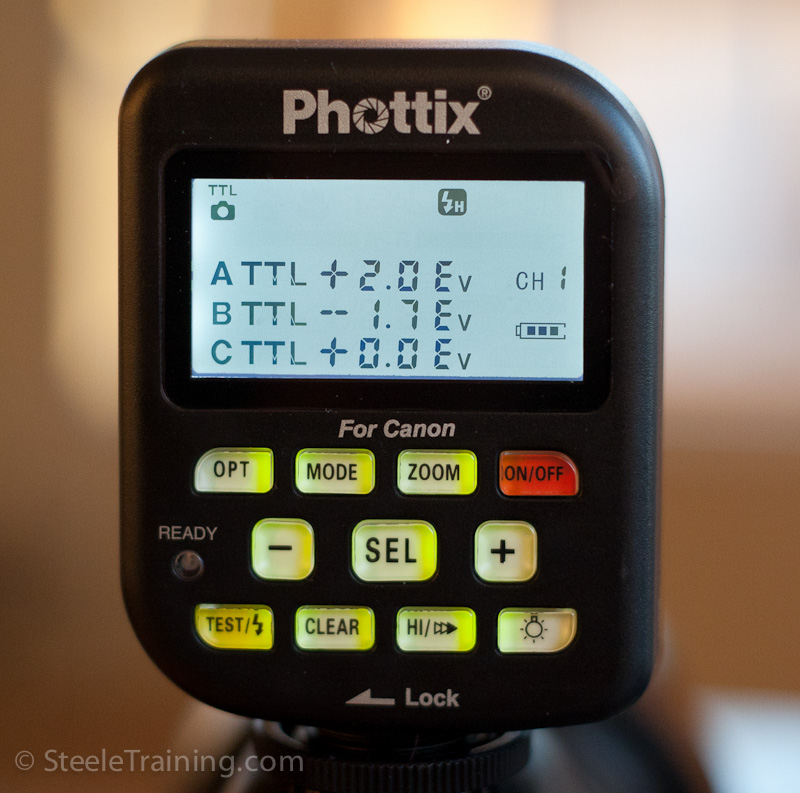
Phottix Odin Transmitter
My Phottix Odin flash triggers just arrived, and oh, man, it’s like Christmas came early at my house.
Finally a gear-maker has delivered all the features I’ve been wanting in a flash trigger for years!
- TTL Metering? – Check
- High Speed Sync? – Check
- Second Curtain Sync? – Check
- Manual Power Settings? – Check
- Multiple Groups? – Check
- Backward Compatibility with cheaper triggers? – Check
- Super Low Price? – Well, um… six out of seven ain’t bad
Seriously, I can’t think of anything that is missing from these triggers. Technology has finally caught up to my fantasy wish list.
So, why is this trigger a big deal?
First of all, it’s one of only a few TTL triggers on the market. The others, including the Pocketwizard Flex System, and the RadioPoppers, are ridiculously expensive, and in the case of PocketWizard, known to have some radio interference issues with Canon flashes.
So the Odin is newsworthy with its lower price point, rock-solid reliability, well-built construction, and user-friendly operation. (I managed to set it up and test it without even consulting the manual.)
The price point looks even better when you consider the backward compatibility with older Phottix triggers, like the affordable Strato and Strato II Multi. (You can see my previous reviews of those triggers by clicking those links).
Of course, any flashes attached to the older Strato series receivers don’t transmit TTL information. But frankly, for me, this is not a problem. Because in a given lighting setup, I typically want only my main and fill lights in TTL mode, while my rim lights or background lights are locked down in manual mode anyway.
So the Odin gives me a perfect way to use the heap of Strato receivers that I already own—to power my manual back lights, while using my Odin receivers for the front lights in TTL mode.
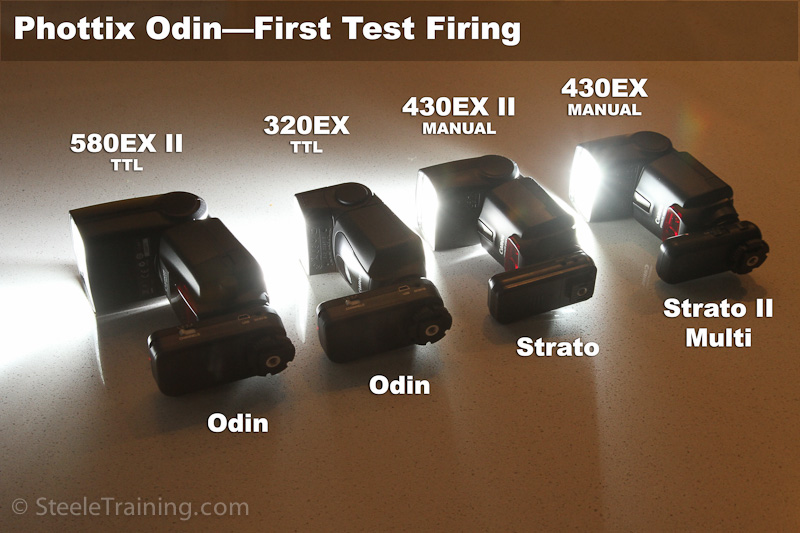
Odin Test with Speedlites (click to enlarge)
I set up a little test rig just to illustrate this mix-and-match scenario for you. The moment I un-boxed the new Odin, I attached my two Odin receivers to two TTL Canon flashes (for the main light), and then I put some older Strato and Strato II receivers on two additional Canon flashes in manual mode, to serve as back/rim lights.
In other words, I’m using four different types of Canon flashes, and three different types of Phottix triggers, all at once. How’s that for mix-and-match?
See the nearby image of my first test firing of the four flashes, on my kitchen counter. Straight out of the box, first shot, and everything is firing. I love it when stuff just works!

Odin Indoor Test with 4 Flashes
It was raining outside, so I couldn’t do the “overpowering the sun with high-speed sync” shot I had in mind, so, instead I dragged the lighting setup into my living room and bribed my daughter to stand in for a few test shots.
You can see my lighting setup nearby, and the photo that resulted from it. (Mind you, this was not an attempt to create art, it was just me confirming that the gear works and that all the flashes and triggers were firing and doing what they are supposed to.)
It went perfectly, with no misfires, and accurate TTL metering on the subject in every shot. It just works.
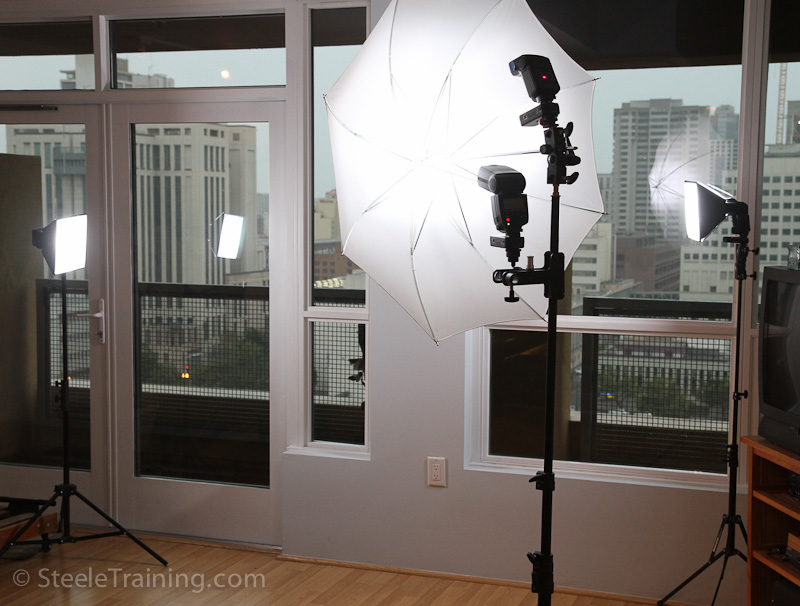
Odin Indoor Test Lighting Setup
The next day the weather cleared up, so I again bribed the offspring to stand for a few shots, this time out on the deck in bright sunlight. This was the test I wanted. Can I overcome the sun with a speedlight in High-Speed sync while using a wide aperture for backgrdound blur?

Odin Outdoor Test (1/1000 sec) HSS
You bet I can. See the shot nearby. She is rim lighted by the sun. Note the blur on the buildings in the background from a f/4.5 aperture. That required a shutter speed of 1/1000. Try doing that with your manual flash triggers!
All right, you may be saying, but I could do that with the Canon or Nikon built-in wireless flash system. But you couldn’t. Not in this configuration. See my lighting setup shot.

Odin Outdoor Test Lighting Setup
From my shooting position, I was standing nearly beside my main light, too far forward for the flash to see a master’s signal. And the fill light was hidden behind a concrete wall!
With Canon or Nikon wireless, no line of sight means no communication. With the Odin, I don’t have to worry about line-of-sight between my master unit and my flashes.
Now I’m free to move around and put my lights wherever I like. This is liberation.
I think you can see now why I’m excited about these triggers.
The Odin is available for both Canon and Nikon, and early users are also reporting that the Odin works with many third-party flashes, but you’ll have to do your own research there, as Phottix makes no promises (and who can blame them?)
Now that I think about it, there is one thing Phottix left out of the Odin that would be handy. The infrared focus assist beam that you get with an on-camera Speedlite or a Canon ST-E2 transmitter can be a lifesaver in low-light situations. (Of course, that beam still shines from your remote TTL flash, but it won’t do much good if it’s firing into an umbrella.) For some shooters who do a lot of low-light work, that could be a problem.
But for me, even without that little feature, these are simply the best flash triggers I’ve ever seen.
Check Odin pricing at the Phottix Store
P.S. If this techie stuff seems over your head—or beyond your budget—you might want to start with my beginner off-camera-flash course which teaches you the basics of how to get started with off-camera-flash on a shoestring budget.



great article Phil! dang these triggers look awesome!! about time someone came along and shook up PW – they’ve had the monopoly for far too long now. i’ll definitely be checking these bad boys out. cheers!
Phil –
Thanks for the review. I’m very interested in these triggers, especially given their price point. One question – did you by any chance test the distance range? The reason I ask is that I have the Phottix Plato for remotely triggering my camera, and I’ve found that the maximum working range between the receiver and transmitter is significantly less than advertised. I’d be interested to see how the range is on the Odin since I use these primarily for sports photography, where I may on the other side of a basketball court or farther.
Fantastic! Phil Thank you I will wait for Nikon version as I am a Nikon.
Phil,
This really does sound good but I have a question about them. (I didn’t ask at the factory because they might not “want” to find out.)
Can you test if it works without a problem when a wireless home phone, that uses a similar frequency, is being used at the same time and close to the transmitter and/or the recievers.
I have some real old Phottix units that seemed like they messed up in the basic transmission department. Maybe they were just bad units but a phone close by was being used at the time. I chalked them off as a lesson learned not to buy cheap stuff and haven’t used them ever again.
Where is Odin for Nikon!!!!!!! Am using Yongnuo, but having TTL would be fantastic!
Hi Phil, I am a community college photography student and, hopefully, an aspiring portrait and art photographer. I have a Hasselblad film camera but I do not have strobes as they are pretty expensive (I like Pro Photo). Do you happen to know if there is any way I can rig my Nikon speedlights to communicate with my Hasselblad so I could use them for off camera flash lighting. My guess is probably not but I thought I’d ask someone that will know more than I. Thanks so much for your blog and helpful hints. I love reading about your experiences and ideas. Sharon
I love the phottix that i just bought (4 recievers) and trigger! I bought them on your recommendation and just love them. Now i have to start saving for this! I like that you can use the other phottix triggers a good sell for me. Just don’t try to order from them on a tight schedule for a shoot… it takes a while to ship from Hong Kong. I love your tutorials and appreciate your continuous updates, best money i ever spent on your tutorials and refer to them All the time! You saved me hours in light room … Thank you!!!
Sincerely Renee
I am very interested in these radio triggers, How is the overall build quality and have you tried using them at longer distances?
Phil, any idea when Nikon version might release?
Dang…$350 a pop. I really like this trigger but think I will hold off for that price drop. I got the Yongnuo’s on your recommendation and they work great for manual flash operation. The TTL metering would sure be nice.
Phil,
once again excellent and relavent info on this complex subject. It really does tick all the box’s and when I have some money I will by one.
Thanks
Hi Phil,
Thanks for the detailed overview of the Phottix Odin flash trigger.
I think that the ability to control the power output of the strobe is of the most important thing to look for in a flash-trigger, and, unfortunately, not all flash-triggers that are on the budget have that ability.
Now…all I have to do is wait until it gets to Israel so I can test it myself… 😉
Ariel Cohen
This is good news! Does this come separate for Canon and Nikon?
Hi there!
I too just bought this fantastic triggers after trying to get the PW flex to work for nearly three years without luck. What I’m wondering is a little off topic, but where did you buy, and what type of flash bracket-mount did you use for the lowest of the two flashes in the shoot-throug umbrella I see in the picture above? That looks genius!!
Hi Viggo,
That bracket is a Manfrotto 175F-1 Spring Clamp with Flash Shoe, you can find it on Amazon. I love these things, you can clamp them anywhere.
Phil
@Rembrandt – Yes separate versions, and at this time Canon only, but they say Nikon version coming soon.
Do you know if the Odin tirggers the pre-flash with Canon flashes even when the flash is set for manual mode? I recently purchased the Odin triggers after reading your review and tried to use my light meter with the flashes set to manual mode. The photos were always way over exposed. I’m wondering if the pre-flash was being triggered, throwing off the light meter reading.
If this is the case, do you know a way to prevent the pre-flash? I sent this question to Phottix a few weeks ago, but never received a response.
Thanks for all your great tips and training videos!
Vic Lewchenko
Vic, that’s an interesting question and I don’t know the answer. I usually don’t use a light meter so I haven’t encountered it. I’ve found Phottix responsive in the past, try them again, maybe your message got lost. If you don’t get a reply contact me privately and I’ll give you the CEO’s email address. And if you do get an answer, please let us know what you learn.
Phil
so if i understand correctly if you want to fire 4 speedlights you will have to buy 4 receivers using the trigger to fire them all? why can’t you use say canon 580EXII as the mater and they link the other speedlights as slaves? and only by 1 receiver and connect to your master speedlight?
Want to shoot off camera flash so was searching for which triggers purchase. My preference is for TTL triggers to be used for Canon 5Dmark11 and canon 580’s. Thank you for a great review on these Odin triggers and the Stratto II.
Phil just a quick question, when shooting weddings indoors I would like the option of putting a flash on camera for bounce / fill in flash, would you recommend I get the Stratto II first? Or would you recommend another system?
Great write up. I have been seriously considering these, but I also want to have the ability to use a Sekonic 758DR light meter. Do you know if the Odin for Nikon is compatible with using the Sekonic to trigger the Phottix in TTL and Manual settings?
I am shooting the Nikon D7000, with SB900s and SB800s…
Hey Phil Steele, Thanks for the great post! This past Christmas, I treated myself with a Phottix Odin Trigger/Receiver Kit for Canon and 2 more extra receivers. I’m shooting with a Canon Rebel T2i and was wondering if there is a way for me to check if I’m setting the Phottix Odin to the correct settings in my camera and need step by step instructions. During a test, I noticed that while metering at full power, I was getting a 4.0 on my meter and new this was wrong because I was only 3-4 feet away and my camera was set to 8.0. Any tips for me to check if I’m using the Phottix Odin correctly or if it is compatible to my camera at all. Any advise would be greatly appreciated. Thanks!
Very useful article, just bought these for my Nikon D800 and SB910’s, looking forward to trying them out 🙂
Hey Phil, You’ve always been able to help before and hopefully you can now. I bought the Odin and two receivers. I have the transmitter on my Canon 7D and the receiver on a Canon 580EXII and I can’t get the Odin to fire in other than ETTL. I can set the Odin to manual and set the power, but it only seems to fire in ETTL when I go into my external flash function menu on the Canon 7D I can select Manual, however whenever I hit the set it defaults to ETTL. Is there something I am missing that I need to do?
Thanks for you help.
Hi and thanks for the review! I want to buy and use these for weddings. Is there a way I can “attach” a speedlight on camera in the same time with the transmitter? The transmitter doesn’t have any hotshoe for the blitz to be slide in, but you said “So the Odin gives me a perfect way to use the heap of Strato receivers that I already own—to power my manual back lights, while using my Odin receivers for the front lights in TTL mode.” How can you use the front lights in TTL mode, through what method? Please answer, I have to buy them urgently 🙂 Thanks a lot!
Ema, with the Odin you can’t have a flash on camera. Your front light will have to be off camera either held by you or an assistant or a light stand.
Thanks a lot for the answer! I decided to buy Strato II for now and maybe later the more complex Odin.
Just ran across this older post and thread. I’m looking to get a set of TTL triggers and a second flash to go with my sb700. I’m wondering if anyone has learned whether the Photix Odin will fire a Yongnuo 565ex or 568ex? I like the features of the photix compared to the YN triggers. The YN flash saves some $$ over another Nikon speed light. thanks much! BTW. Nikon d7000 body.
Hey Phil, I have a question. I noticed that youre using 4 flashes with phottix remotes, but I see that the Odin only has 3 groups (A,B,C). Im about to purchase the just released Nikon Mitros+! I have been waiting for it to be released for MONTHS! I currently own several sets of strato II which I love cause I have 4 groups. How are you using 4 flashes?
Great review! I was wondering if you know a answer to my question in regards to the Phottix Odin system. I am currently using as Nikon D750 with a Phottix Ares and a Canon 550EXII Speedlight (The Ares works on both Nikon and Canon as I switched from canon to Nikon but still own the flash). I am looking upgrade to the Phottix Odin system with the Phottix Mitros Flash but was curious if I were to buy 1 Strato receiver for Canon would the Nikon Phottix Odin transmitter fire the canon one? I have been looking online to see if the system fires both the Nikon and Canon version and can’t seem to find an answer. I know I could fire the Canon flash with the Mitros Flash using the Canon in Optical Slave mode but if line-of-sight is lost then It won’t work so I am curious if the Phottix Strato (Canon Version) receiver could be fired from the Nikon Odin, mainly as a basic Radio trigger as I am not worried about the TTL or Highspeed sync since the Mitros can do that duty. I am trying to save some money and would like to have a two flash system. It may sound silly to use the Canon Flash with the Nikon but it was given to me by my Dad and holds some sentimental value (It also works great with the Ares system as a single light setup in Manual). Thank you for your time on this long winded question lol.
-Tim-
To answer two of the “shortcomings” of the Odin system highlighted in this thread:
1) You can have on camera flash at the same time as having the Odin trigger sitting in your body’s hotshoe simply by using a bracket. Attach an Odin receiver plus your gun to the bracket. The compact and robust Custom Brackets CB Mini-RC works great . If you use a body with a large battery grip you may want to raise the height of the brackets seat. I no longer use battery grips as current battery life is far better than it used to be – which was once the main reason for me using grips.
This should also give you focus assist in low light if you’ve set the gun to do that, if its facing forwards (n.b. not bounced), and if you set the body to single shot rather than servo.
2) The pre-flash fools the Sekonic flash meter, so the workaround is to set the flashguns to rear curtain sync, set a shutter speed of a few seconds, press the shutter, then press the button on the light meter to measure the flash output. This way it measures only the main flash dump at the end of the shutter period.
Whoops – you don’t need to have the gun facing forwards for the focus assist to work, it will work when bouncing, just tested it. Also works with the STE2
I am using the odin trigger with Phottix Indra 500 and triggering some speed lights Nikon 900, 910, Yongnuo568EX. I do use a light meter and had the same problem until I found that you can set the test button in version 1.06 (NIKON) of the updated odin trigger. In manual mode, It makes two flashing and the second flash is the one to meter on. There is a delay of 2,5 second in between. It will also fire the YN568EX atleast with phottix odin receiver for Nikon.